- cybersecurity policies
Cybersecurity vs. Information Security: What's the Difference?
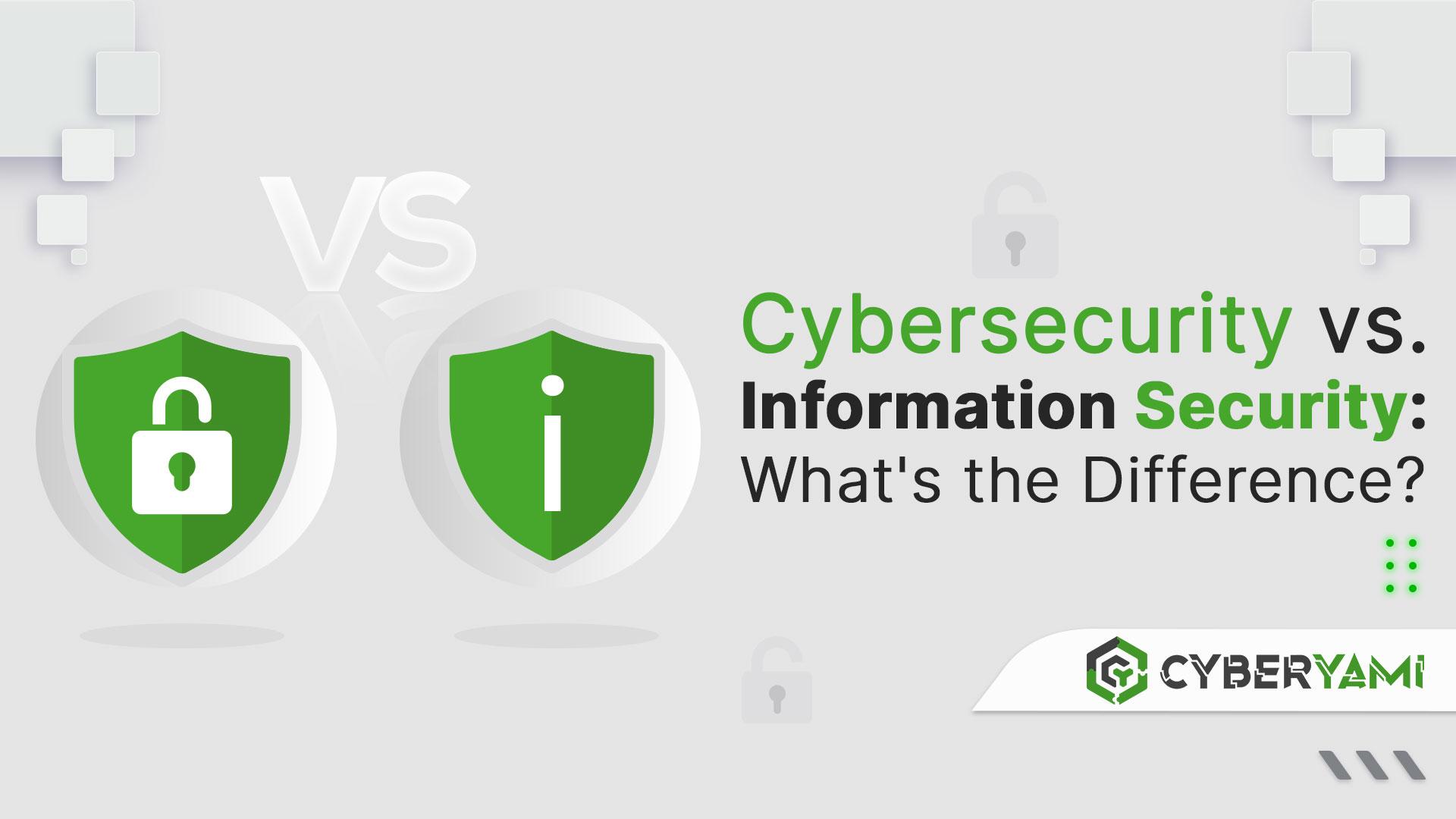
"Cybersecurity" and "information security" get used as if they're interchangeable — in job postings, in vendor pitches, even inside security teams. They're not the same thing, and the difference isn't academic. Get the scope wrong, and you end up with a security program that's excellent at stopping malware but has no policy for the printed contract sitting on someone's desk, or a compliance framework that covers paperwork but leaves the network exposed.
Here's the distinction, how the two fields overlap, and which certifications map to which career path in 2026.
The Quick Answer
Cybersecurity is a subset of information security. Cybersecurity protects digital systems, networks, and data from online threats. Information security protects all information — digital, physical, and human — throughout its entire lifecycle. Every cybersecurity problem is an information security problem; not every information security problem is a cybersecurity problem.
Understanding Cybersecurity
Cybersecurity is the practice of defending computer systems, networks, applications, and data against unauthorized access, breaches, and attacks. It's specifically concerned with the digital attack surface: endpoints, cloud infrastructure, networks, and the software running on them.
In 2026, that attack surface has expanded well beyond what it looked like a few years ago. Security teams are now defending against AI-generated phishing that's harder to spot than the old typo-riddled scams, ransomware-as-a-service operations that don't require the attacker to write their own code, and supply chain attacks that compromise a business through a vendor rather than a direct hit. Most cybersecurity teams now anchor their program to a recognized framework — the NIST Cybersecurity Framework (CSF) 2.0 is the most widely adopted, organizing defense into six functions: Govern, Identify, Protect, Detect, Respond, and Recover. (NIST Releases Version 2.0 of Landmark Cybersecurity Framework, 2024)
Cybersecurity is fundamentally reactive-and-proactive: it's about building the technical controls (firewalls, endpoint detection, network monitoring) and the incident response muscle to catch and contain attacks as they happen.
Information Security: The Bigger Picture
Information security (often shortened to "InfoSec") is the umbrella discipline. It governs the confidentiality, integrity, and availability — the classic CIA triad, covered in more depth in What Are the "Essential" Pillars of Cyber Security? — of information in any form: a database, a signed contract in a filing cabinet, a conversation in a meeting room, an employee's knowledge of a client's account details.
Information security management is built around policy and process, not just technology. It covers:
- Data classification — deciding what's public, internal, confidential, or restricted
- Access control — who is allowed to see or handle what, and under what conditions
- Risk management — identifying and prioritizing threats to information assets, digital or not
- Governance and compliance — meeting legal and regulatory obligations
- Physical security — locked server rooms, badge access, clean-desk policies, secure disposal of paper records
The standard reference framework here is ISO/IEC 27001:2022, which certifies an organization's Information Security Management System (ISMS) — the policies and controls that govern information handling company-wide, not just the IT stack. (ISO/IEC 27001:2022 - Information security management systems, 2022)
Cybersecurity vs. Information Security: Side by Side
| Cybersecurity | Information Security | |
| Scope | Digital systems, networks, devices, data in transit/at rest | All information — digital, physical, verbal |
| Primary concern | Preventing and responding to cyber attacks | Confidentiality, integrity, availability (CIA triad) of all information assets |
| Typical controls | Firewalls, EDR/XDR, SIEM, encryption, MFA, penetration testing | Data classification policy, access governance, physical security, employee training, audit programs |
| Governing frameworks | NIST CSF 2.0, MITRE ATT&CK, CIS Controls | ISO/IEC 27001:2022, NIST SP 800-53, SOC 2 |
| Threat examples | Ransomware, phishing, DDoS, supply chain compromise | All of the above, plus insider leaks, document theft, social engineering, unsecured physical archives |
| Leadership role | CISO, Security Engineering Lead | CISO or Information Security Manager, with legal/compliance and HR |
| Relationship | A subset of information security | The umbrella discipline that includes cybersecurity |
Where They Overlap
In practice, most mid-size and enterprise organizations don't run cybersecurity and information security as two separate departments — they run one security function, usually under a CISO, with cybersecurity as the technical execution arm and information security as the governance and policy layer within which it operates. A phishing simulation program, for example, is a cybersecurity control (it targets a digital attack vector) that's justified and measured through an information security lens (it reduces human risk to the confidentiality of company data).
This is also exactly where regulation pulls the two together. A framework like ISO 27001 or India's Digital Personal Data Protection (DPDP) Act, 2023, doesn't care whether a data leak happened because of a hacked server or an employee emailing a spreadsheet to the wrong address — both are information security failures, and increasingly, both carry legal consequences. The DPDP Rules, 2025, notified in November 2025, are being enforced in phases through May 2027, with penalties running up to ₹250 crore for serious violations. (Digital Personal Data Protection Act, 2023, 2023) That's pushing Indian enterprises to treat data governance — not just network defense — as a board-level priority.
Roles, Responsibilities, and Who Reports to Whom
Cybersecurity professionals are the technical front line: SOC analysts, penetration testers, security engineers, incident responders. Their day-to-day is vulnerability scanning, threat hunting, patching, and responding when an alert fires. Success is measured in things like mean-time-to-detect and mean-time-to-respond.
Information security professionals operate at a layer up: security governance leads, compliance managers, risk analysts, and the CISO, who sits across both. Their day-to-day is policy design, risk assessments, audit prep, vendor risk reviews, and translating technical risk into business risk that a board will actually act on. Success is measured in audit outcomes, policy adoption, and reduced organizational risk exposure — not just blocked attacks.
Neither role works well in isolation. A cybersecurity team without information security governance ends up firefighting without clear priorities. An information security program with no cybersecurity execution ends up as a policy binder nobody follows.
Skills and Certifications for Each Path
If you're headed toward cybersecurity (hands-on, technical):
- Core skills: network security, intrusion detection, malware analysis, incident response, vulnerability assessment
- Certifications: Certified Ethical Hacker (CEH), CompTIA Security+, OSCP for penetration testing, CompTIA CySA+ for threat hunting/SOC roles
If you're headed toward information security (governance, risk, compliance):
- Core skills: risk management, data classification, access control design, security governance, regulatory compliance (ISO 27001, DPDP, GDPR)
- Certifications: Certified Information Systems Security Professional (CISSP), Certified Information Security Manager (CISM), Certified Information Systems Auditor (CISA)
Most senior security leaders end up holding certifications from both lists — CISSP in particular is designed to bridge both worlds, which is why it's often the baseline expectation for a CISO role.
Why This Distinction Matters for Your Business
For a growing organization, this isn't just semantics — it changes what you budget for and who you hire first. A company that only invests in cybersecurity tooling (firewalls, endpoint protection, a SOC) but has no information security governance will still fail a compliance audit, still have no answer for "who's allowed to access customer PII," and still be exposed to the single largest cause of breaches: human error, not malware.
That's the gap most generic security-awareness training misses — it teaches people to spot a phishing email but doesn't connect that behavior to a measurable, governable risk posture. That's the layer Cyberyami's Human Risk Management platform is built for: it sits on top of technical cybersecurity controls and gives CISOs and CHROs a way to actually govern human risk — scoring, tracking, and reporting on it the way an information security program requires, not just running a once-a-year training module and calling it done.
If you're building out a security function from scratch, the practical order is usually: baseline cybersecurity controls first (you can't govern what isn't protected), then layer in the information security governance — policy, classification, training, audit readiness — that turns those controls into something a regulator, a customer, or a board will actually trust.
FAQs
Is cybersecurity a subset of information security?
Yes. Information security is the broader discipline covering all information in any form; cybersecurity is the part of it focused specifically on digital systems and networks.
Which pays more, cybersecurity or information security roles?
It varies by seniority and region more than by field. Hands-on cybersecurity roles (penetration tester, SOC analyst) and governance-focused information security roles (compliance manager, security auditor) have comparable mid-level ranges; leadership roles like CISO — which require both skill sets — typically pay the most.
Do I need both cybersecurity and information security programs, or just one?
You need both functions, even if they're run by the same team. Cybersecurity without governance leaves you unable to prove compliance or manage risk; governance without technical cybersecurity controls leaves you with policies that nothing enforces.
Does information security cover physical security?
Yes — locked facilities, secure document disposal, and controlled access to physical records all fall under information security, since the goal is to protect information regardless of the medium in which it's stored.
Want to see how human risk management fits into your existing security stack? Talk to Cyberyami about the Human Risk Management platform, or explore business solutions for tailored enterprise training.
Related Reads
- What Are the "Essential" Pillars of Cyber Security?
- Why Employee Awareness Training Is Your Cheapest Insurance Policy
- Ways to Protect Your Business from Cyber Threats
- Supply Chain Attacks: Protecting Your Business Ecosystem
References
(February 26, 2024). NIST Releases Version 2.0 of Landmark Cybersecurity Framework. NIST. https://www.nist.gov/news-events/news/2024/02/nist-releases-version-20-landmark-cybersecurity-framework
(2023). Digital Personal Data Protection Act, 2023. Ministry of Law and Justice. https://www.dpdpact2023.com/final_dpdp_rules
(2022). ISO/IEC 27001:2022 - Information security management systems. International Organization for Standardization. https://www.iso.org/standard/27001
(July 1, 2023). 3 best professional certifications for CISOs and aspiring CISOs. TechTarget. https://www.techtarget.com/searchsecurity/answer/What-CISO-certifications-are-the-most-important-to-have
Recent Blogs
How Encryption Algorithms Actually Work (Without the Math Headache)
Why Employee Awareness Training Is Your Cheapest Insurance Policy
From People to Processes: How Integrated Cybersecurity Training Platforms Elevate Organizational Readiness
Zero Trust for Beginners: Why "Trust No One" is Your Best Defense
Supply Chain Attacks: Protecting Your Business Ecosystem
Top 30 SOC Analyst Interview Questions and Answers for 2025
The Role of Certifications in Bridging the Cybersecurity Skills Gap
Why Every Business Needs Tailored Cybersecurity Training

Unveiling Lucrative Paths: Exploring Cybersecurity Career Opportunities