- Penetration Testing
What is penetration testing? | Lifecycle & types of Penetration Testing
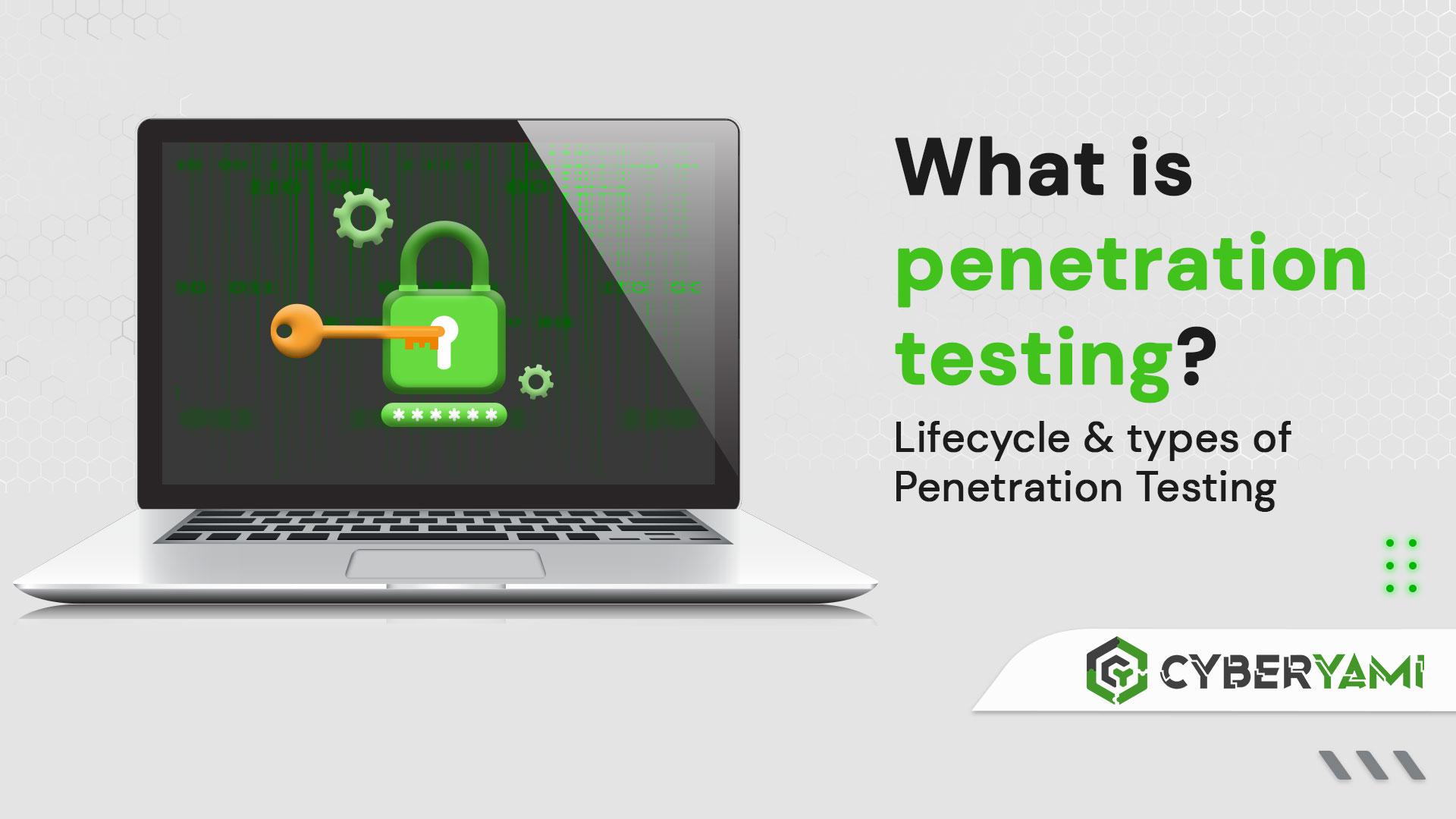
Penetration testing — also called pen-testing or ethical hacking — is the practice of hacking "legally," documenting findings and methodology, and reporting them to the organization that authorized the test. Several types exist, each covering different infrastructure:
- Network Penetration Testing (wired & wireless)
- Web Application Penetration Testing
- Mobile Penetration Testing
- IoT (Internet of Things) Penetration Testing
- Cloud Penetration Testing
Lifecycle of a Penetration Test
The typical flow runs:
Engagement → Information Gathering/OSINT → Footprinting & Scanning → Vulnerability Assessment → Exploitation → Reporting
Engagement involves two parties — the tester and the business commissioning the test — agreeing on scope, restrictions, and documentation, such as an NDA.
Information Gathering is where testers should invest real time. Passive gathering uses OSINT (publicly available information); active gathering comes directly from the target — its site, premises, and infrastructure.
Footprinting/Scanning — often called banner-grabbing — comprehensively scans the system, website, or premises. Nmap is the standard tool here, scanning for open ports and running services to map entry points.
Vulnerability Assessment identifies which entry points could be exploited and ranks them by risk — a SQL injection vulnerability scores far higher than a minor information leak.
Exploitation is where a tester attempts to exploit a confirmed vulnerability — turning a SQLi flaw into actual access to a database, for instance.
Reporting documents findings precisely enough for the business to patch and secure its systems, typically including proof-of-concept evidence and mitigation guidance.
Network Penetration Testing
Networks are the backbone of any organization's infrastructure. Attackers target them because a foothold allows them to pivot and access valuable data across connected systems. Network Penetration Testers verify server room access controls, firewall/IDS/IPS configuration, and — where appropriate — honeypot deployment to detect intrusion attempts early.
Wireless security has come a long way: WPA3 is now the standard, having succeeded WPA2, WPA, and the long-deprecated WEP (trivially crackable and now essentially extinct in serious deployments). Wireless testing remains its own specialization within network penetration testing.
Web Application Penetration Testing
Web Application Penetration Testing (WAPT) remains one of the highest-demand specializations, simply because much of what organizations run is delivered as web apps — built on frameworks like Node.js and React, and backed by databases like MySQL or MongoDB. Testers need familiarity with this stack to find real vulnerabilities, most of which map to the OWASP Top 10, though plenty exist outside that framework too.
OWASP Top 10
The OWASP Top 10 remains the industry's baseline reference for the most critical web application security risks — broken access control, cryptographic failures, injection, and insecure design consistently rank among the highest-impact categories. It's a starting point for prioritization, not a complete checklist.
Mobile Penetration Testing
Smartphone usage and app volume have only grown. Mobile Penetration Testing (MPT) covers two main platforms — Android and iOS — each with distinct methodologies for testing, given their different architectures and security models.
Cloud Penetration Testing
Cloud adoption means organizations increasingly rely on providers like AWS, Google Cloud, Microsoft Azure, and IBM rather than maintaining physical server rooms — paying for resources on a pay-as-you-go basis. But responsibility for security doesn't entirely transfer to the provider; the shared-responsibility model means that misconfiguration on the customer's side remains one of the most common causes of cloud breaches. That's exactly why Cloud Penetration Testing (CPT) has become one of the fastest-growing specializations in the field.
IoT (Internet of Things) Penetration Testing
IoT means connecting everyday objects — smart homes, connected cars, smart appliances — to the internet via embedded microprocessors. Securing these requires knowledge that spans traditional penetration testing and hardware/firmware analysis. It remains one of the newer, fastest-evolving corners of the discipline, and demonstrations of connected-vehicle and smart-device hacks at conferences like DEF CON continue to push the field forward each year.
Why Should Businesses Perform Penetration Tests?
Skepticism about penetration testing has largely faded — data breach costs keep climbing (the global average now sits above $4 million per incident), and no business wants to be the next headline. Testing frequency depends on company size and release velocity: large, fast-moving organizations often test continuously or near-continuously; smaller businesses might test with every major feature push or on a quarterly cadence.
How Much Time Does a Penetration Test Take?
Duration depends on scope and team size. A single tester can typically cover a small business's footprint in 3–5 days. Large enterprises usually engage a dedicated team to work across multiple attack surfaces simultaneously, which can take months, depending on the scope. Tests can be performed remotely or on-site.
Want to see how a structured penetration test fits into a broader security program? Read Ways to Protect Your Business from Cyber Threats, or explore Penetration Testing Certifications: Which One Is Right for You? If you're building a career in this space.
Related Reads
Recent Blogs
How Encryption Algorithms Actually Work (Without the Math Headache)
Why Employee Awareness Training Is Your Cheapest Insurance Policy

From People to Processes: How Integrated Cybersecurity Training Platforms Elevate Organizational Readiness

Zero Trust for Beginners: Why "Trust No One" is Your Best Defense
Supply Chain Attacks: Protecting Your Business Ecosystem

Top 30 SOC Analyst Interview Questions and Answers for 2025

The Role of Certifications in Bridging the Cybersecurity Skills Gap

Why Every Business Needs Tailored Cybersecurity Training

Unveiling Lucrative Paths: Exploring Cybersecurity Career Opportunities